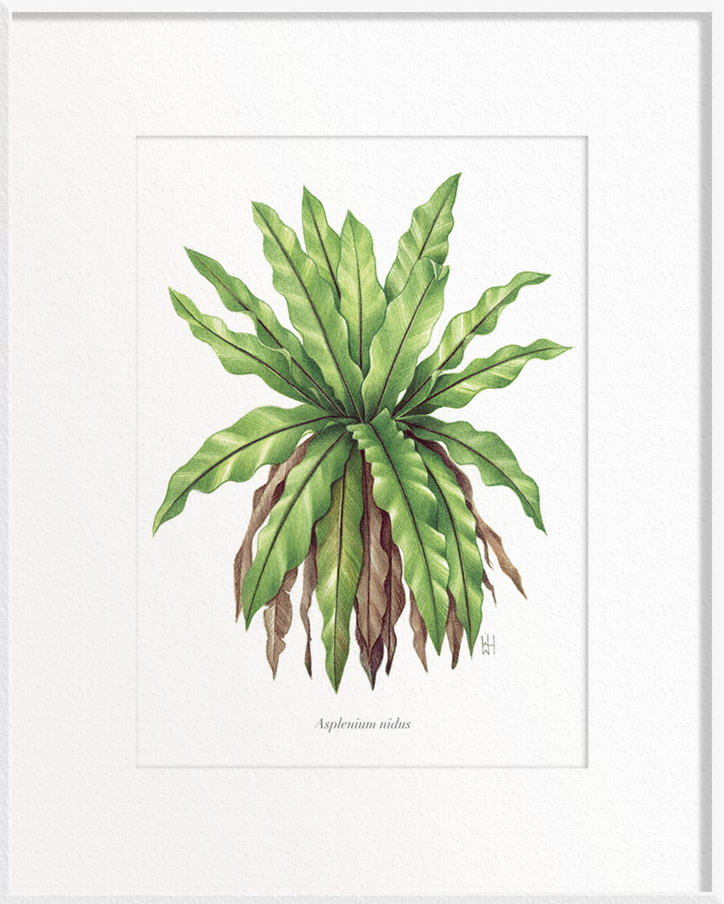
hawaiian birds nest fern Asplenium nidus (Bird’s-Nest Fern)
SKU: 75358572340
hawaiian birds nest fern

hawaiian birds nest fern Asplenium nidus (Bird’s-Nest Fern)

Sale price$24.16 Regular price$26.84
Save 10%

Pay in installments of $6.71 with ShopPay, AfterPay and Klarna

Shipping Estimate
USA
  • USA
  • CAN

Ships within 48 hours · Estimated delivery Jun 29 - Jul 4

Promo Codes Available:

For Your Every Summer RSVP, with Code: SUMMER15

Description

hawaiian birds nest fern Asplenium nidus (Bird’s-Nest Fern)Asplenium nidus is an epiphytic species of fern commonly known as birds nest fern or nest fern, within the family Aspleniaceae. It is native to tropical Southeast Asia, eastern Australia, Hawaii, Polynesia, Christmas Island, India and east Africa. The large rosette or nest of large, simple green fronds is similar to banana leaves and is typically seen wedged in the branches of large trees. These ferns are not parasites and do not suck any water or

Asplenium nidus is an epiphytic species of fern commonly known as bird’s-nest fern or nest fern, within the family Aspleniaceae. It is native to tropical Southeast Asia, eastern Australia, Hawaii, Polynesia, Christmas Island, India and east Africa. The large rosette or nest of large, simple green fronds is similar to banana leaves and is typically seen wedged in the branches of large trees. These ferns are not parasites and do not suck any water or nutrients off the host tree. It can thrive terrestrially, but usually grows on organic matter. It collects water and humus in the leaf rosette. Genus Asplenium means ‘without spleen’, a reference to the fern’s application as a cure for spleen ailments. In Malaysian traditional medicine, an infusion of the leaves is used to ease labour pains and a lotion obtained from the leaves is used to treat fever.

°°°°°

Specifications:

Paper
100% Cotton based, 320g, Acid-free, No optical brighteners. 

Printed Area
A4, 210mm x 297mm – Approximately 142mm x 210mm
A3, 297mm x 420mm – Approximately 230mm x 319mm

About the Collection

The Garden of Miss Joaquim Collection: Illustrated Botanical Prints

Agnes Joaquim was a Singapore-born Armenian who created what would become Singapore’s National Flower, the Vanda Miss Joaquim (scientific name: Papilionanthe Miss Joaquim), in 1893. The artificial hybrid was recognised by the first director of the Singapore Botanic Gardens, botanist Henry Ridley.

Agnes, the first woman in the world to create a hybrid orchid, was a well-known and successful horticulturist, garnering 70 horticultural awards from 1881 to 1899. The Garden of Miss Joaquim Collection of botanical prints commemorates her horticultural legacy and complements her story told in the book Agnes and Her Amazing Orchid.

In presenting Agnes’s award-winning plants in the illustrated collection, we looked at the newspaper records of the times, but they were of no use because they used common name descriptions of the plants, such as ‘rose’ and ‘durian’. So we turned to the Singapore Botanic Gardens and collaborated with a botanist to identify the likely species. To complete Agnes’s story, the collection includes two additional images: of Vanda Miss Joaquim’s parents, Papilionanthe teres (pod parent) and Papilionanthe hookeriana (pollen parent) — formerly in the genus Vanda — both of which may have been present in her award-winning floral bouquets or cut flowers. Waiwai Hove, a talented and respected botanical illustrator, was chosen to produce the prints.

*Disclaimer: Representative only based on subject. Not species definitive.
About the Illustrator

Born in Kuala Lumpur, Malaysia, Waiwai Hove developed a love for nature from a young age. Growing up surrounded by rich tropical flora and nurtured by her mother, a keen gardener, Waiwai has always held a special place for plants in her childhood memories. She holds a diploma in botanical illustration from the Society of Botanical Artists (UK), graduating in 2013 with a distinction and the highest marks in the history of the course. 

She has since worked for the Singapore Botanic Gardens, where highlights include illustrations for ‘30 Heritage Trees’ and more recently ‘15 Gingers’. Four of Waiwai’s ginger paintings were subsequently used for a series of stamps issued by Singapore Post in 2018. Since 2019, Waiwai has begun working on the cover illustrations of 14 volumes of The Flora of Singapore, to be published over the next few years. Her works are in numerous private collections and can also be found in publications by the National Parks Board and in the Shirley Sherwood Collection in Kew Gardens, UK.

Shipping Notes
  • Free Standard Shipping on $100+ Orders to the USA.
  • Except Preorder products are shipped in 48 hours.
  • Delivery to the USA:
  1. Standard Shipping : 3-10 business days
  • If time is of the essence, please consider selecting expedited delivery for faster service.
Exchange/Return Notes
  • We offer a 30-day return/exchange service after receiving.
  • Final sale items are not eligible for returns or exchanges.
  • To process your return/exchange, please contact us at [email protected]
  • Please click here for more details>>> Return & Exchange Policy
SKU: 75358572340

Discover Niche Categories That Outsell hawaiian birds nest fern

Top-Converting Item to Boost Your Average Order

4.2 ★★★★★
Based on 1367 reviews
Sort
Highest Rating
Newest First
Oldest First
Product Reviews
B
Verified Purchase
Becca
Bozeman, US
★★★★★ 5
Poignant, truthful look at women as powerful, business-savvy, yet brutal slave owners
Format: Paperback
Women slave owners were the norm in the South, not the exception. They increased in numbers, stature, and power while the men were off fighting the Civil War. Women often owned the slaves, not the men and knew how to sign prenuptial agreements back then to insure they kept all their property (including slaves) upon divorce or death of their spouse. They traded and bought and sold slaves with business savvy that most men envied. And they could be just as brutal towards their slaves. Ironically, it was the ownership of other people that empowered these women to not be bound to their husbands.
WAS THIS REVIEW HELPFUL?YesReportShare
Reviewed in the United States on January 26, 2025
B
Verified Purchase
Brown David
Massapequa, US
★★★★★ 4
Good history, but not fun, engaging in popular literature.
Format: Paperback
The author is a very competent historian, and proves her points. She does so by stating each thesis and then reciting an exceedingly long string of supporting examples. Rinse and repeat. This is high quality, academic style history, but it’s not very engaging as popular literature. No one’s going to say “I couldn’t put it down.” That being said - I liked it! I learned a lot. Thanks.
WAS THIS REVIEW HELPFUL?YesReportShare
Reviewed in the United States on March 1, 2023
T
Verified Purchase
Tsukiko Brown
San Leandro, US
★★★★★ 5
Should be required
Format: Paperback
In my opinion, this book should be required reading in high school/college history classes. It’s so important to learn accurate history when it comes to slavery and this book does that. White women played a larger role than we are taught. Please give this a read!
WAS THIS REVIEW HELPFUL?YesReportShare
Reviewed in the United States on October 23, 2025
S
Verified Purchase
shaleah newmam
Louisville, US
★★★★★ 5
No regets
Format: Paperback
This was a good book to read! In school you only learn the male prospective during slavery! I know feel I can say white woman played a major role during slavery times. I like that fact that the Author put in the information to where we can go srwcah and read for ourselves. The visuals where an added touch. I feel like because alot of women of that time couldn't write so alot of information was missing. I feel like this is a must read.
WAS THIS REVIEW HELPFUL?YesReportShare
Reviewed in the United States on April 9, 2025
A
Verified Purchase
AuthorAnnaBella
New York, US
★★★★★ 5
One of the most poignant books I have read in a long time.
Format: Paperback
One of the most poignant books I have read in a long time. “Southern communities, lawmakers, and courts recognized slave-owning women as individuals able to acquire and exercise mastery over enslaved people, s is evident from laws passed throughout the South. Laws dating back to the colonial period routinely recognized the mistresses owned enslaved people in their own right, and these same laws acknowledged the fact that these women were capable of exercising mastery over the enslaved people they owned.” Stephanie E. Jones - Rogers. They were referred to as Southern Belles’. Revered for their ladylike daintiness. But… there was nothing dainty about their dealings for they too, owned human property. These white southern mistresses were heavily involved and often owned more property than their male counterparts even being the breadwinners. These women were barbaric and wore the crown of cruelty. Dr. Rogers gave the enslaved a voice in this text – allowing our ancestors to share with us their story and experiences under the thumb of white mistresses. This text uncovers the extent of the involvement that white women had with slave ownership. There was discord in marriages due to white women struggles to maintain control of their financial gains of human property. These women utilized the judicial system to protect their pecuniary interests. The parents of these white girls/women bequeathed slaves to white females i.e. as young as newborns – which leads us to mistresses in the making – that is the education of young white women of the mastery of slave ownership. My heart broke as I was able to envision the accounts of atrocities inflicted upon our ancestors. Our people were raped and forced into being breeders and wet nurses to ensure the livelihood of these white mistresses and their families. The evidence is insurmountable in all the ways slave-owning women invested in, and profited from their financial ties to American slavery and its marketplace. Most importantly, there was testimony from formerly enslaved people of their experiences within slavery. This text is a mandatory read for all and in my opinion, must be included as part of the curriculum in schools.
WAS THIS REVIEW HELPFUL?YesReportShare
Reviewed in the United States on October 16, 2020

recommand products